
The Council of Media Ethics of Macedonia (CMEM) presented details at today’s press conference on the number of complaints received and reviewed in 2024, as well as the identified violations of the Code of Journalists in media reporting.
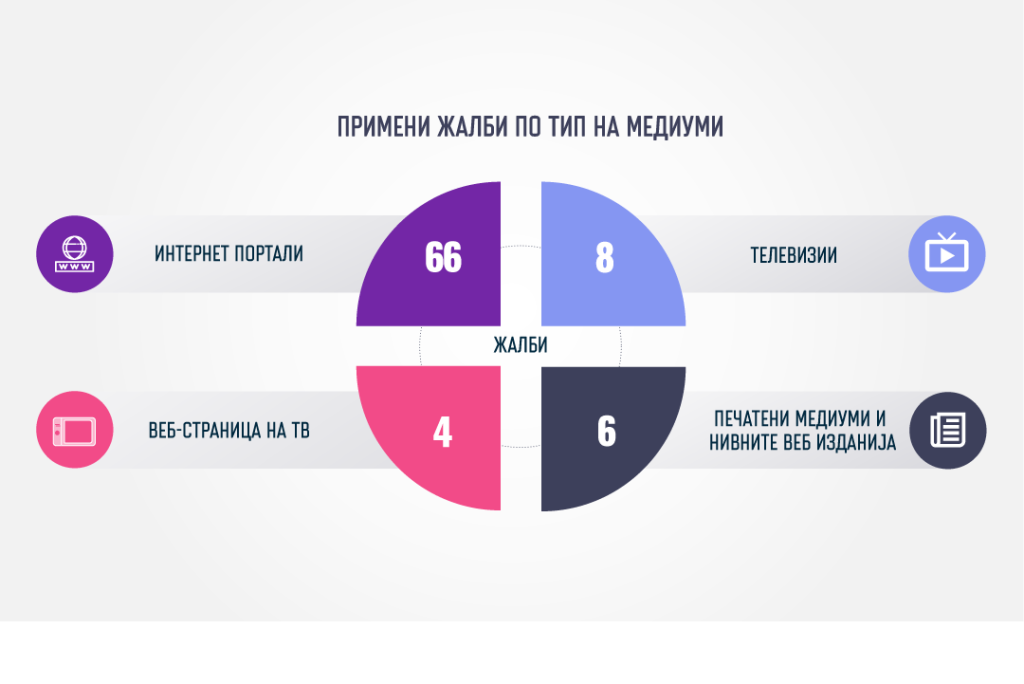
A total of 84 complaints were submitted last year to the Complaints Commission within CMEM by citizens, institutions, and non-governmental organizations. In 33 cases, a violation of one or more articles of the Code of Journalists was found, while in 21 cases no violation was found. Most complaints, as in the past few years, were submitted against content in online media, as many as 66, while the rest concern content on television and in newspapers.
The majority of complaints were submitted by civil society organizations (27), followed by citizens (26), public institutions (9), and public office holders (8). Politicians and political parties filed a total of 8 complaints against media content last year.
The most frequently violated article of the Code of Journalists is Article 1, which states that “a journalist should publish accurate information, verified to the greatest extent possible”. Out of the total number of decisions and opinions issued by the Complaints Commission, Article 1 was violated in 22 cases, accounting for 34.4%.
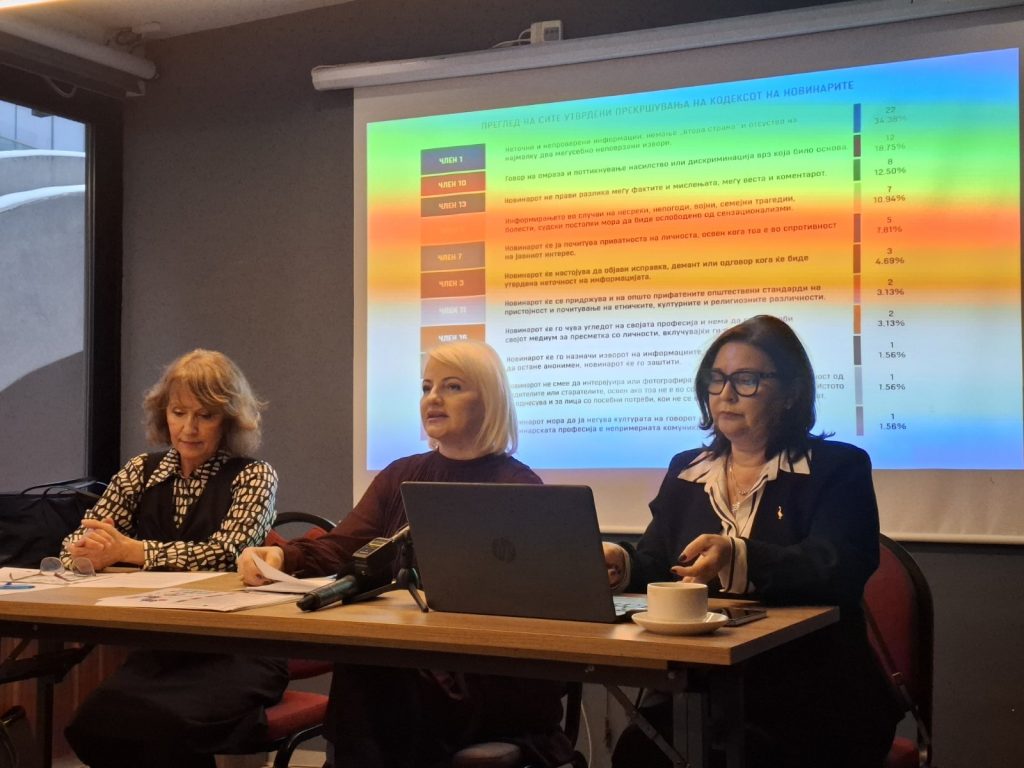
The second most frequently violated in 2024, as in the previous year, is Article 10 of the Code, which states: “a journalist shall not consciously create or process information that jeopardizes the human rights and freedoms, shall not speak with the language of hatred and encourage violence…”. The Complaints Commission determined that Article 10 was violated in 12 cases, representing 18.75% of the total number of violations.
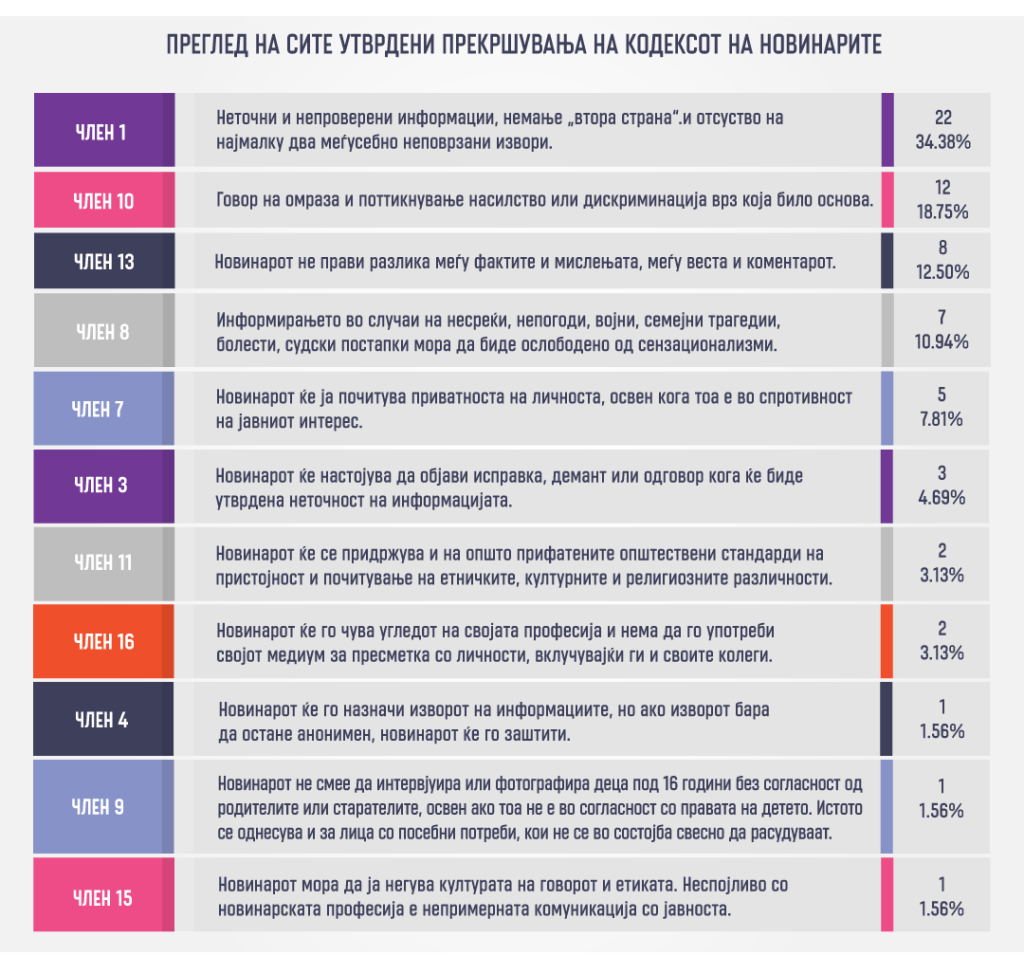
This is followed by Article 13 (the journalist does not distinguish between news and commentary), Article 8 (reporting in cases of accidents must be free from sensationalism), Article 7 (a journalist shall respect a person’s privacy), and others.
Out of the total number of reviewed complaints (59), five cases were resolved through reconciliation between the complainant and the media (mediation).
Compared to 2023, the number of complaints received in 2024 decreased by nearly one third, which may be interpreted in different ways: fewer violations in the media or lower public interest in correcting media content through the self-regulatory mechanism, particularly during the period of the general and presidential elections held in the country in 2024.
CMEM calls on media outlets to respect the “rules of the game”, i.e. the standards for ethical and professional reporting, as the best way to safeguard freedom of expression and media independence. At the same time, CMEM calls on institutions to be more transparent in order to enable accurate and timely public information. Demanding professionalism from the media and journalists, while not providing them with timely and accurate information of public interest, places the media in an unequal position and hinders timely and transparent information for citizens.
The work of the Complaints Commission within CMEM is supported by the UNESCO project “Building Trust in Media in South East Europe: Support to Journalism as a Public Good”, funded by the EU. The main objective of the project is to enhance and promote freedom of expression in South East Europe through the promotion of free and independent media, recognition of journalism as a public good, and the fight against disinformation.